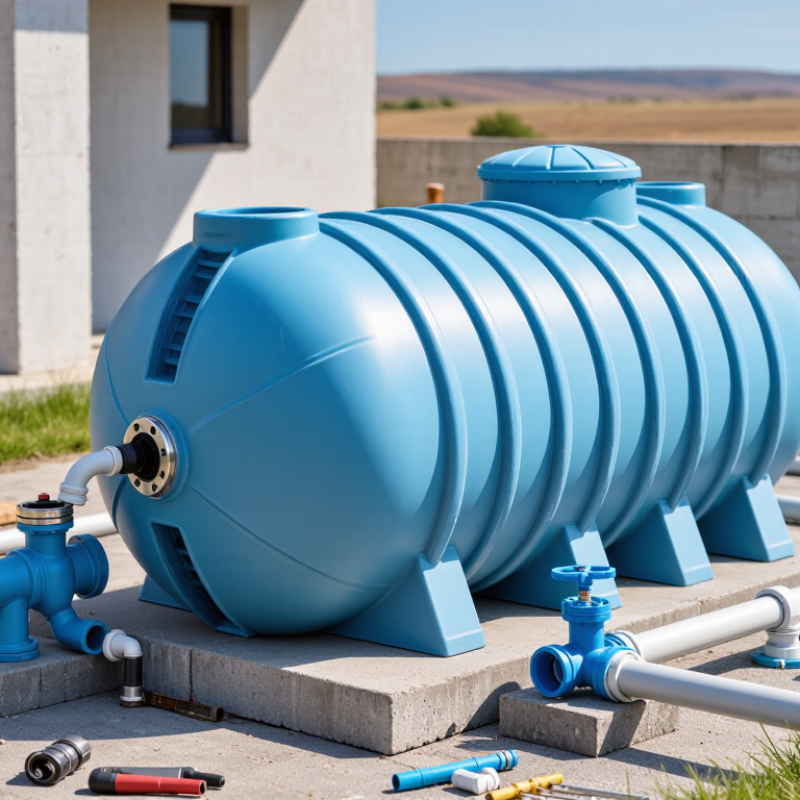
Choosing plastic water storage tanks in 2026 requires more than comparing prices and capacities. The right tank protects water quality, withstands local conditions, and supports dependable daily use. A tank may look strong in a showroom, yet fail early under intense sunlight, uneven ground, or poor installation.
Real-world selection begins with the water’s purpose. Drinking water needs certified, food-grade polyethylene and compatible fittings. Irrigation may allow different specifications, but chemical exposure still matters. Check the tank’s capacity against household demand, emergency needs, and available refill frequency. Oversizing can waste space and increase structural pressure. Undersizing creates frustrating shortages.
Material quality is equally important. Look for UV-stabilized construction, opaque walls, secure lids, and smooth internal surfaces. These details can limit algae growth and simplify cleaning. Inspect wall thickness carefully. It is not always uniform.
Installation deserves equal attention. A level concrete base, correct pipe support, and an accessible overflow outlet can prevent expensive problems. In windy or seismic areas, ask about anchoring recommendations. Local climate matters too. Heat, freezing temperatures, and salt air can change performance over time.
Reliable decisions should come from manufacturer data, independent certification, and advice from qualified installers. Do not trust vague claims. Request warranty terms, maintenance guidance, and replacement-part availability. Standards and water regulations may differ by region, so verify local requirements before purchasing.
A perfect choice is not guaranteed. Needs change. Review the tank after installation, watch for leaks, and record cleaning dates. Small observations, such as a loose lid or unusual odor, can reveal larger concerns. With careful research and realistic planning, plastic water storage tanks can provide safe, efficient, and long-term water storage.
Choosing a plastic water storage tank begins with demand, not the available space beside your building. Estimate daily use from residents, staff, livestock, cleaning, toilets, and irrigation. Then plan for peak periods, such as summer afternoons or a weekend gathering. A household using 600 liters daily may need 600 to 1,800 liters for one to three days of storage. Add a practical reserve if deliveries are unreliable. Do not size the tank from average use alone. Peak demand is often twice the quiet-day figure.
Keep a simple usage log for one week. Record shower times, laundry loads, watering cycles, and any water loss. This field check is more reliable than guessing from household size. Calculate tank volume, then confirm that the pump, pipes, and roof structure can handle it. A large tank is not automatically better. It can occupy valuable space, cost more, and hold water longer than necessary. Stagnation deserves attention. Use a covered, food-grade tank, inspect the inlet screen, and clean it according to local health guidance. Leave room for safe access. My own early estimates have been too optimistic. Weather, visitors, and a leaking valve can quickly change the numbers. Recheck demand every season.
In 2026, potable-water storage should begin with material safety, not tank color or advertised capacity. Choose polyethylene certified to NSF/ANSI/CAN 61. This standard evaluates materials and components that contact drinking water for contaminant leaching. “Food-grade” alone is not enough. It can describe a resin, but not the complete tank, fittings, or manufacturing process.
The WHO/UNICEF Joint Monitoring Programme reported that 2.2 billion people lacked safely managed drinking water in 2022. That figure makes storage hygiene more than a technical detail. Inspect the certification scope carefully. It should cover potable-water contact and match the tank’s intended temperature and use. Ask for current certification records, resin information, and maintenance guidance. Do not rely on a printed label.
Look inside the tank. The surface should be smooth, clean, and free from strong odors, loose particles, or visible manufacturing residue. A tight lid, screened vent, and accessible drain reduce contamination risks. Keep the tank shaded when possible, because heat can accelerate material aging and encourage biological growth.
The U.S. Environmental Protection Agency’s 2023 Drinking Water Infrastructure Needs Survey estimated $625 billion in drinking-water infrastructure needs over 20 years. Storage equipment is only one part of that system, but weak material choices can undermine the whole chain. A certified tank still needs inspection. Certification does not replace cleaning, correct installation, or periodic water testing. I would also verify local requirements before purchase, because capacity rules and testing practices can differ. Small omissions matter.
How to Choose Plastic Water Storage Tanks in 2026?
When comparing polyethylene water tanks, begin with ASTM D1998. This specification addresses upright tanks made by rotational molding. It covers material requirements, dimensions, workmanship, and basic performance expectations. However, ASTM D1998 is not a substitute for site engineering. Tank selection still depends on water temperature, installation height, wind exposure, and foundation quality.
Rotational molding creates a seamless tank with no welded side joints. During a factory inspection, check the inner surface for thin patches, bubbles, cracks, or sharp irregularities. Wall thickness should be reasonably consistent, especially near the base and fittings. Ask how the manufacturer controls resin quality, mold temperature, cooling time, and demolding. These details affect impact resistance and long-term shape retention. Small defects matter.
Design details also deserve close attention. A flat, unsupported base can deform on uneven concrete. Fittings should match the pipe load, not merely the pipe size. Covers need secure seating, while vents must prevent pressure problems without allowing debris inside. Use potable-water-approved materials when storing drinking water, and request test records that identify the actual tank material. Standards help, but paperwork can hide limitations. I would still inspect the tank, measure the support area, and question vague claims about “heavy duty” construction. Local codes may require additional checks for anchoring, access, sanitation, or seismic conditions.
| Design and Selection Dimension | Vertical Open-Top Tank | Vertical Closed-Top Tank | Horizontal Leg or Saddle Tank | Underground or Below-Grade Tank | Recommended Verification |
|---|---|---|---|---|---|
| Capacity, Geometry and Layout | |||||
| Typical planning capacity | 500–5,000 US gal (1,900–18,900 L) |
500–10,000 US gal (1,900–37,900 L) |
300–5,000 US gal (1,100–18,900 L) |
500–10,000 US gal (1,900–37,900 L) |
Confirm usable volume, freeboard, access clearance and local installation requirements. |
| Illustrative 1,000-gallon footprint | Approximately 1.5 m diameter × 2.0 m high | Approximately 1.5 m diameter × 2.0 m high | Approximately 1.2 m diameter × 2.7 m long | Size according to excavation, buoyancy and structural calculations | These are planning values only; actual dimensions vary with mold, fittings and design loading. |
| Space efficiency | High vertical efficiency Requires a stable, level base. |
High vertical efficiency Suitable where contamination control is important. |
Good under low headroom Requires correctly positioned supports. |
Concealed installation Requires excavation and engineered backfill. |
Compare tank diameter, total height, service access and foundation area—not capacity alone. |
| Shape suitability | Best for atmospheric storage with gravity or pump withdrawal. | Best for protected water storage and controlled access. | Best where height is restricted or a low center of gravity is preferred. | Best where above-ground space, appearance or temperature exposure is a concern. | Use a geometry that avoids unsupported flat panels and minimizes concentrated stress. |
| ASTM D1998 and Rotational-Molding Considerations | |||||
| ASTM D1998 relevance | Generally applicable For rotationally molded polyethylene vertical tanks used for above-ground liquid storage. |
Generally applicable Confirm that the specific closed-top configuration is covered by the supplier’s compliance documentation. |
Configuration-specific Confirm applicability because horizontal support and handling loads can differ from vertical tank assumptions. |
Do not assume compliance Underground service requires separate structural, buoyancy and installation engineering. |
Request a current declaration of conformance, technical data sheet and design limitations for the exact tank model. |
| Rotational-molding quality controls | Uniform wall distribution, complete fusion, controlled cooling and absence of visible voids or cracks. | Uniform wall distribution around the roof, neck, lid and fittings. | Uniform wall distribution in curved ends and support-contact areas. | Requires additional review of deformation, external pressure and backfill conditions. | Review molding process records, visual inspection results and dimensional checks. |
| Wall thickness selection | Determine from liquid head, tank diameter, material properties, temperature, UV exposure and safety factor. | Determine from the same loads plus roof, access opening and fitting stresses. | Determine from liquid head, saddle spacing, lifting loads and local support reactions. | Determine through an engineered calculation for soil, groundwater, traffic and installation loads. | Do not select a tank by nominal wall thickness alone; distribution and reinforcement are also important. |
| Material | Rotational-molding-grade polyethylene suitable for the intended water and temperature conditions. | Rotational-molding-grade polyethylene with suitable lid and fitting compatibility. | Rotational-molding-grade polyethylene with adequate impact and support-load performance. | Polyethylene specifically designed and documented for below-grade service. | Obtain resin identification, applicable regulatory documentation and temperature limits. |
| UV protection | Use UV-stabilized material for outdoor exposure; opaque colors help limit light transmission. | Use UV-stabilized material and an opaque lid or cover to reduce light entry. | Use UV-stabilized material when installed outdoors. | UV exposure is usually lower, but exposed access covers and risers still require protection. | Confirm UV-stabilizer provision and expected exposure conditions. |
| Water Quality, Connections and Operation | |||||
| Potable-water suitability | Verify documentation Use only material and components approved for drinking-water contact where required. |
Verify documentation Pay particular attention to lid seals, vents and internal fittings. |
Verify documentation Confirm that all wetted components meet the applicable jurisdictional requirements. |
Verify documentation Check potable-water requirements for tank, coating, liner, fittings and installation materials. |
Approval is jurisdiction-specific; ASTM D1998 alone is not a drinking-water approval. |
| Typical connections | Bottom outlet, top inlet, overflow, drain, vent and optional level sensor port. | Bottom outlet, top inlet, screened vent, overflow, drain and sealed access opening. | Top or end inlet, low-point drain, vent, overflow and level sensor port. | Top access riser, inlet, outlet, overflow, vent and inspection access. | Specify connection size, material, location, flexible coupling and isolation valves. |
| Ventilation | Required to prevent vacuum during drawdown and pressure during filling. | Required; use a screened, weather-protected vent sized for the maximum flow rate. | Required; protect the vent from blockage and water ingress. | Required through the access or vent arrangement; prevent gas accumulation where applicable. | Never operate a non-pressure tank as a sealed pressure vessel. |
| Cleaning and inspection | Large top opening generally provides straightforward access. | Access opening must be large enough for safe inspection and cleaning. | Access may be more restricted because of the horizontal geometry. | Plan access, confined-space controls and inspection before installation. | Provide drainability, safe access and a cleaning schedule appropriate to water use. |
| Structural, Environmental and Installation Risks | |||||
| Base or support requirement | Continuous, level, smooth support; commonly a reinforced slab or engineered platform. | Continuous, level support with clearance for outlet and drain connections. | Engineered saddles or legs with correct spacing and load distribution; do not support on sharp points. | Engineered bedding and backfill; follow the installation sequence and groundwater limitations. | Check allowable settlement, bearing pressure, support spacing and connection flexibility. |
| Wind and seismic exposure | Assess anchorage, overturning and sloshing when installed outdoors or in seismic regions. | Assess tank, lid, vent and fitting loads together with anchorage. | Assess sliding, rolling, saddle restraint and impact during seismic or wind events. | Assess flotation and soil interaction, especially with a high groundwater table. | Use local building, seismic, wind and flood requirements; these loads are not established by tank capacity alone. |
| Temperature range | Confirm the supplier’s maximum liquid and ambient temperature limits; polyethylene properties change with temperature. | Confirm temperature limits for tank, lid, gasket and fittings. | Confirm limits under both full and empty conditions, including solar heating. | Confirm limits for buried service, groundwater temperature and installation materials. | Do not use a general polyethylene temperature value in place of the exact material specification. |
| Pressure classification | Atmospheric only Not intended for internal pressure or vacuum unless specifically engineered. |
Atmospheric only The closed lid does not make the tank pressure-rated. |
Atmospheric only Protect against pump shutoff pressure and blocked vents. |
Atmospheric only External soil and groundwater loads still require engineering. |
Install pressure relief, overflow and vacuum protection where the system could create abnormal pressure. |
| Expected service-life factors | UV exposure, temperature cycling, chemical compatibility, impact, support settlement and maintenance. | UV exposure, lid and gasket condition, vent blockage, fitting stress and cleaning practices. | UV exposure, saddle condition, transport damage, impact and cyclic support loads. | Backfill quality, groundwater, flotation, traffic loads, soil movement and access maintenance. | Specify inspection intervals and replace damaged tanks, fittings or seals rather than relying only on age. |
| Selection Summary | |||||
| Best general choice | Above-ground general storage | Protected or controlled-access storage | Low-clearance installations | Space-limited sites with engineered installation | Choose the simplest design that satisfies capacity, access, water quality, structural and regulatory requirements. |
| Key purchase documents | Capacity, dimensions, resin data, UV information, connection schedule, support requirements and conformance statement. | All vertical-tank documents plus lid, vent, gasket and access-opening details. | All tank documents plus saddle spacing, support reactions, lifting instructions and restraint details. | All tank documents plus burial depth, backfill, groundwater, flotation and traffic-load requirements. | Request drawings and calculations for the exact configuration, not only a general product brochure. |

Choosing a plastic water storage tank in 2026 requires more than checking its capacity. UV stabilization should be a primary concern for outdoor installations. Look for resin or additives designed to resist prolonged sunlight exposure. Without protection, plastic may become brittle, fade, and develop surface cracks. I have seen tanks installed under strong sun deteriorate sooner than expected. Shade helps, but it does not replace proper UV resistance.
Wall thickness should match the tank’s size, shape, and installation conditions. A thicker wall usually improves rigidity, but thickness alone does not prove quality. Ask for material specifications, manufacturing tolerances, and test information. Inspect the base and lower sidewall carefully, because these areas carry substantial water pressure. Small details matter. A slightly uneven foundation can create stress that weakens the tank over time.
Fittings deserve equal attention. Confirm that outlets, valves, gaskets, and threaded connections match the pipe system. Poorly matched fittings often cause leaks during maintenance. Check whether replacement parts remain available locally. Temperature limits are also easy to overlook. Read the technical sheet for minimum and maximum service temperatures, especially for rooftop or freezing environments. Heat can accelerate deformation, while freezing water can expand and damage connections. My own preference is to leave a practical safety margin rather than operate at the stated limit. I sometimes over-specify this point, but replacing a full tank is far more disruptive than selecting a safer design.
Choosing a plastic water storage tank in 2026 requires more than comparing capacity and price. Installation details often decide whether a tank performs safely for years. Ask for a site plan, foundation requirements, inlet height, overflow route, and access space before ordering. A full tank is extremely heavy. Never place it on uneven soil, cracked concrete, or a weak platform. Check local plumbing and structural requirements with a qualified installer. Small errors become expensive.
I once inspected a tank positioned too close to a wall. The valve could not be reached. That mistake delayed cleaning and encouraged neglect. Leave room for inspection, drainage, and safe hose connections. Secure outdoor tanks against wind, movement, and accidental impact. Confirm that fittings match the pipe material and that overflow water cannot flood nearby foundations. Keep installation photos and written records for future warranty claims.
Maintenance should include scheduled cleaning, sediment checks, lid inspection, and examination of seams and fittings. Use only cleaning methods approved for potable-water contact. Keep insects, sunlight, and debris away from openings. Read the manufacturer’s warranty before purchase, not after a leak. Check coverage periods, installation conditions, exclusions, replacement procedures, and who pays transport or labor. Ask whether warranty service requires approved installers or maintenance records. Get answers in writing. Vague promises are not protection. A longer warranty may still be weak if its conditions are unrealistic.