What Are the Best CNC Machine Tools in China?
Choosing the best CNC machine tools in China depends on more than price or spindle speed. Buyers must match machine capacity, accuracy, controls, service support, and workload. A compact three-axis mill may suit a small workshop, while a heavy-duty five-axis center serves complex aerospace parts. The right choice is specific.
China’s manufacturing base makes this comparison especially relevant. The International Federation of Robotics reported that China installed 276,288 industrial robots in 2023, accounting for 51% of global installations. This figure describes industrial robots, not CNC machine tools. Still, it signals the scale of automation demand surrounding Chinese production. The China Machine Tool Industry Association’s annual industry reporting also offers useful context on domestic sector performance, though broad industry totals cannot rank individual brands or models. That distinction matters.
This guide evaluates manufacturers and machines through practical criteria: positioning accuracy, rigidity, available configurations, controller options, delivery, and after-sales support. It also considers whether published specifications reflect real production conditions. A brochure may list rapid traverse speed, for example, but buyers should ask how the machine performs under sustained cutting and what maintenance it needs. Data helps, but it does not replace inspection. Some comparisons remain imperfect because test methods and model configurations differ. We will make those limits clear while identifying the CNC machine tools worth shortlisting in China.
What “Best” Means in China’s CNC Machine Tool Market
In China’s CNC machine tool market, “best” depends on the work a shop needs to perform.
A compact machining center may suit aluminum parts, while heavy steel cutting demands a more rigid frame and stronger spindle. Buyers should match machine travel, tool capacity, and workholding to actual jobs, not just catalog figures. A larger specification is not automatically better. It can mean higher costs and unused capacity.
Performance should be checked through repeatability, thermal stability, service response, and spare-part availability. Ask for a test cut using material and tolerances similar to your own production. Inspect the finished part, listen for vibration, and review measurement records. Local technical support matters when a machine stops; a delayed component can disrupt a whole shift. Still, published accuracy figures do not tell the full story. Installation, operator skill, and maintenance affect results too. The comparison is imperfect. A useful choice balances verified performance, lifecycle cost, and the team’s ability to keep the machine running.
Main Types of CNC Machine Tools Made in China
Main Types of CNC Machine Tools Made in China
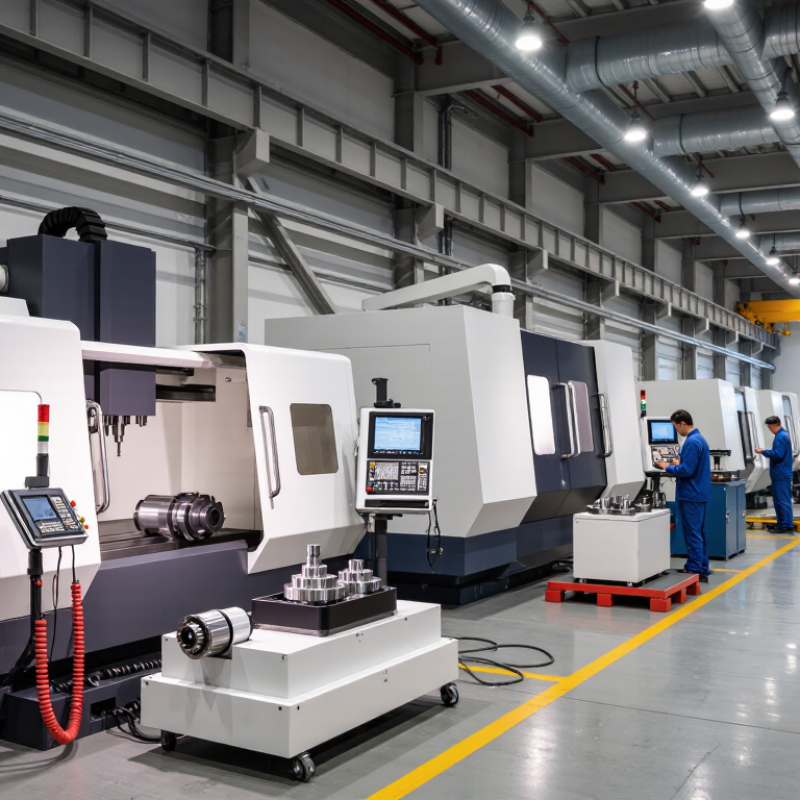
Chinese CNC machine tools cover several distinct processes. CNC lathes rotate bars or castings while cutting tools shape their surfaces. They commonly produce shafts, threaded parts, and hydraulic fittings. Vertical and horizontal machining centers combine milling, drilling, and tapping, often within one setup. That can reduce handling time, though results still depend on tooling and operator skill.
CNC grinders finish hardened parts where surface quality and dimensional accuracy matter. Wire-cut and sinker electrical-discharge machines shape conductive materials with electrical sparks, useful for intricate dies and narrow slots. CNC press brakes and punching machines serve sheet-metal shops; laser-cutting systems handle profiles and plate. These categories sometimes overlap in supplier catalogs, so check the machine’s actual axis count, working envelope, and control functions.
Automation is part of the production context, not proof of machine quality. The International Federation of Robotics’ World Robotics 2024 report records 276,288 industrial robot installations in China during 2023, about 51% of global installations. That figure describes robot installations, not CNC machine output. For buyers, test a representative workpiece and inspect repeatability, spindle performance, and service support. A brochure cannot cut metal.
Leading Chinese Manufacturers and Their Strengths
China’s leading CNC machine-tool manufacturers often compete through production scale, broad machine ranges, and strong local supply networks. Gardner Intelligence’s 2023 World Machine Tool Survey estimated China’s 2022 machine-tool consumption at about US$27.1 billion. That large domestic market can support investment in machining centers, turning equipment, and application-specific systems. Buyers may also find easier access to local service teams and replacement parts. Details vary by factory.
Automation is another strength, though it should not be confused with machine accuracy. The International Federation of Robotics reported 276,288 industrial robot installations in China in 2023, or 51% of global installations. This reflects a substantial automation ecosystem around machine tools. It does not prove that every CNC machine offers the same rigidity, thermal stability, or long-term accuracy. Those details matter. Ask for test-cut results, positioning-accuracy records, spindle specifications, and service response times. Check a sample part under realistic cutting conditions, not just a showroom demonstration. I would not treat a large production base as a guarantee; some specifications still need careful verification.
How Chinese CNC Machines Compare in Accuracy, Automation, and Cost
What Are the Best CNC Machine Tools in China?
Chinese CNC machines vary widely in accuracy, automation, and price. Country of origin alone cannot predict performance. Compare the machine’s stated positioning accuracy and repeatability, then ask how these figures were measured. A test cut on your material can reveal more than a specification sheet. Check the finished part at several points, especially around corners and drilled holes. Small details matter. A machine may hold tight tolerances in a controlled test but need regular calibration in a busy workshop.
Automation also differs by configuration. Some machines support automatic tool changes, probing, and workpiece loading; others require more operator attention. These features can reduce idle time, but they add setup and maintenance needs. Consider your actual shift pattern and part volume. Paying for automation that sits unused is a common misstep. Cost should include tooling, installation, training, service, and expected downtime—not just the purchase price. Comparing these items can make a lower initial quote look less compelling.
Tips: Request a sample cut using your material and target tolerances. Ask for a written acceptance test, service response times, and spare-parts lead times. If possible, inspect the machine under production conditions. A supplier’s answer may sound confident, but verify the details; I would leave room for some uncertainty until the machine proves itself on your parts.
How to Choose a CNC Machine Tool for Your Application
Choose a CNC machine tool around the part, not the catalogue headline. List the materials, largest workpiece, required tolerance, and expected weekly volume. A compact mill may suit small aluminum housings, while long shafts need adequate travel and stable support. Match spindle speed and torque to the cutter sizes you actually use. Check that the machine’s working envelope includes room for fixtures, not just the raw part. Rigidity matters. A fast spindle cannot compensate for a frame that vibrates during a heavy cut.
Tips: Take a representative drawing and a sample material to the supplier. Ask for a test cut, then inspect the finish, dimensions, chip removal, and setup time. Bring your fixture plan, too.
Compare the full operating setup: tool capacity, axis configuration, control functions, guarding, and service access. Ask how routine maintenance is performed and which components require local support. A machine that meets a tight tolerance once may not hold it across a long production run; confirm repeatability under realistic conditions. Test the actual process where possible. It can feel like extra work, and sometimes the first trial still raises questions, but those questions are cheaper to resolve before installation.