
Choosing a Fire-Resistant Fan is a life-safety decision, not merely an equipment purchase. NFPA reported that U.S. fire departments responded to approximately 1.5 million fires in 2023. Those incidents caused thousands of civilian deaths and injuries. Smoke movement remains a critical risk during evacuation. A fan that looks durable may still fail when heat, pressure, and contaminated air arrive together.
Fire-protection engineer Robert M. Solomon, a former NFPA division director, offers a useful warning: “Smoke-control equipment must perform under fire conditions, not just appear robust in normal service.” This principle should guide every selection. Check the fan’s certified temperature rating, test duration, airflow, pressure curve, motor location, control sequence, and installation limits. AMCA testing standards and NFPA 92 provide important reference points, while UL listings can confirm whether the complete assembly has been evaluated. Do not rely on the words “fire resistant” alone.
The seven tips in this guide connect technical evidence with field practicality. They examine certification, materials, redundancy, maintenance access, electrical protection, system integration, and supplier competence. Look closely at the nameplate beside a hot, dusty plant wall. Ask whether the quoted performance remains valid at the required temperature. That question is easy to skip. It should not be.
Some specifications still leave room for interpretation, and that is uncomfortable. Product brochures can simplify complex conditions. Therefore, involve a qualified fire-protection engineer before approval, and verify every critical claim against current test reports, codes, and project requirements.
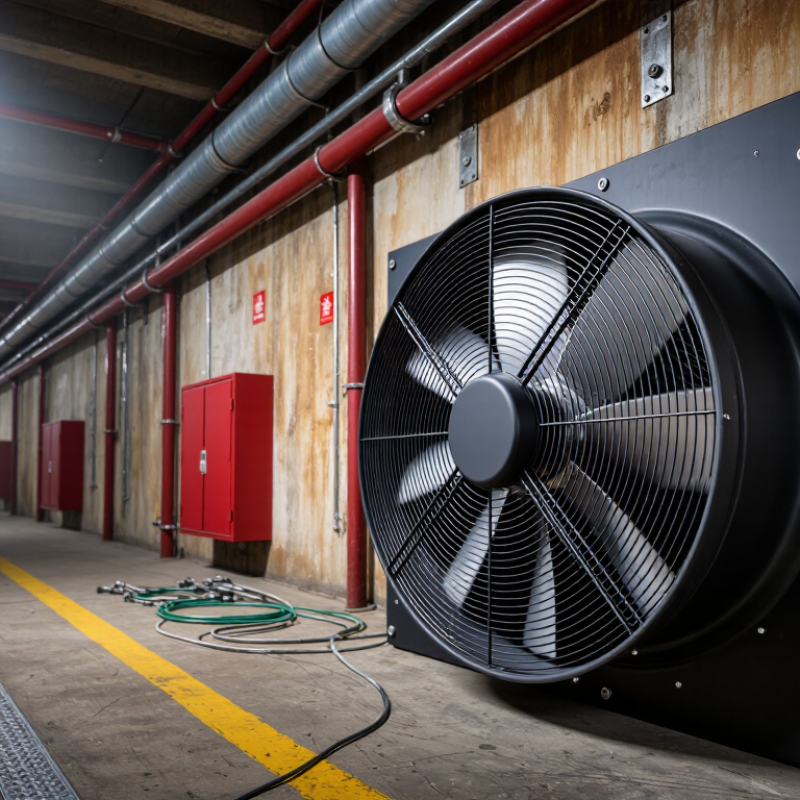
7 Tips for Choosing a Fire Resistant Fan
Define Fire-Resistant Fan Requirements and Operating Conditions
Start with the actual fire scenario, not the fan catalogue. Specify airflow, static pressure, temperature, exposure time, smoke density, and installation location. Under EN 12101-3, common smoke-exhaust classifications include F200 for 120 minutes, F300 for 60 minutes, and F400 for 120 minutes. These ratings describe tested performance, not unlimited protection.
Operating conditions matter every day. Record normal airflow, start-up frequency, ambient temperature, humidity, and corrosive contaminants. A roof-mounted fan faces rain, ultraviolet exposure, and wind pressure. A basement fan may face soot, heat layering, and restricted access. Check whether the electrical supply remains available during a fire. NFPA 92 emphasizes engineered smoke-control systems, including reliable power, pressure relationships, and commissioning.
The scale of risk is substantial. NFPA’s Fire Loss in the United States During 2023 reported about 1.39 million fires and approximately 22.7 billion dollars in direct property damage. That figure supports careful specification, but it does not replace a site assessment. A checklist can still miss an overlooked duct transition or undersized emergency cable. Measure the route, verify fan curves at design temperature, and demand independent test evidence. Do not confuse a high-temperature motor with a complete fire-rated system. Local codes may require different classifications. Recheck them.
| Tip | Requirement to Define | Typical Operating Condition or Data | Fire-Resistant Fan Selection Guidance | Information to Verify |
|---|---|---|---|---|
| 1 | Required Fire Exposure Rating | Smoke-extraction systems may need to operate during a fire at temperatures such as 250°C for 2 hours, 300°C for 1 hour, or 400°C for 2 hours, depending on the applicable design standard and project risk assessment. | Select a fan with a tested temperature-time classification that meets or exceeds the project requirement. The rating should apply to the complete fan assembly, not only to the motor or impeller. | Test certificate, temperature-time curve, test method, duration, and the exact fan configuration covered by the test. |
| 2 | Airflow Capacity | Required airflow is determined by the smoke-control strategy, protected volume, compartment geometry, leakage, and the number of operating fans. Typical building smoke-control systems may require several thousand cubic metres per hour per fan. | Choose a fan that delivers the design airflow at the actual system pressure, rather than selecting by free-air volume alone. Allow for reasonable design margin without causing excessive noise or energy use. | Certified performance curve showing airflow, pressure, speed, power, and efficiency at the intended operating point. |
| 3 | Static Pressure and System Resistance | Pressure losses come from ducts, dampers, grilles, filters, bends, transitions, shafts, and building leakage. The system resistance generally increases approximately with the square of airflow. | Match the fan curve to the calculated system resistance at both normal ventilation and emergency smoke-extraction duty. Check performance at the highest expected duct resistance and at elevated air temperature. | Duct pressure-loss calculation, fan pressure curve, system-effect allowance, and operating-point stability. |
| 4 | Temperature, Smoke, and Air Quality | During a fire, the fan may handle hot smoke containing soot, corrosive gases, and suspended particles. Under normal operation, the same fan may handle ambient air ranging from approximately -20°C to 40°C, subject to the installation location. | Confirm that the impeller, casing, bearings, seals, electrical components, and lubrication system are suitable for both ambient ventilation and emergency smoke conditions. Consider corrosion protection in humid or contaminated environments. | Maximum smoke temperature, ambient temperature range, corrosion category, material specification, bearing arrangement, and maintenance requirements. |
| 5 | Motor and Electrical Supply | Common industrial electrical supplies include three-phase 400 V at 50 Hz or three-phase 480 V at 60 Hz, but the required supply depends on the site. Emergency systems may require separate power sources or backup generation. | Select a motor with sufficient power for the design duty and verify that the motor, cable system, starter, isolator, and control panel can remain available for the required emergency operating period. Variable-speed drives require specific approval for fire-mode use. | Voltage, frequency, current, motor power, starting current, ingress protection, insulation class, emergency power arrangement, and control compatibility. |
| 6 | Mechanical Construction and Installation | Fans may be installed on roofs, in plant rooms, inside smoke shafts, or inline with ductwork. They can be exposed to vibration, weather, thermal expansion, maintenance access limitations, and seismic or structural loads. | Specify casing and impeller materials, shaft alignment, bearing type, mounting arrangement, flexible connections, vibration isolation, access doors, drainage, and weather protection. Confirm that installation orientation matches the tested design. | General arrangement drawing, foundation loads, vibration limits, mounting details, service clearances, lifting requirements, and installation instructions. |
| 7 | Compliance, Testing, and Maintenance | Fire and smoke-control equipment must remain reliable after long periods of standby. Regular inspection may include rotation checks, electrical testing, damper operation, vibration monitoring, control-system testing, and periodic full-duty tests. | Use a fan tested and documented under the regulations applicable to the project location. Establish a preventive-maintenance schedule and ensure spare parts, inspection access, and service support are available throughout the intended service life. | Applicable standards, independent test documentation, factory inspection records, commissioning procedure, maintenance schedule, and replacement-part availability. |
Note: The values shown are representative design considerations. Final fan selection must be based on the project smoke-control calculation, local building and fire-safety regulations, installation conditions, and the certified performance of the complete fan assembly.