
What Is Carbon Filament and What Is It Used For?

What Is Carbon Filament and What Is It Used For?

Carbon Filament is an engineering material designed for stronger, lighter, and more dimensionally stable 3D-printed parts. It usually combines a thermoplastic, such as nylon, PLA, or PETG, with short carbon fibers. These fibers can improve stiffness, reduce warping, and help printed components maintain their shape under moderate mechanical stress.

Joseph DeSimone, co-founder of Carbon and a leading figure in digital manufacturing, has said, “We are a materials company.” That statement matters here. Carbon Filament is not simply dark-colored plastic. Its performance depends on the polymer base, fiber percentage, nozzle temperature, layer direction, and drying condition. Small choices can change the final result.

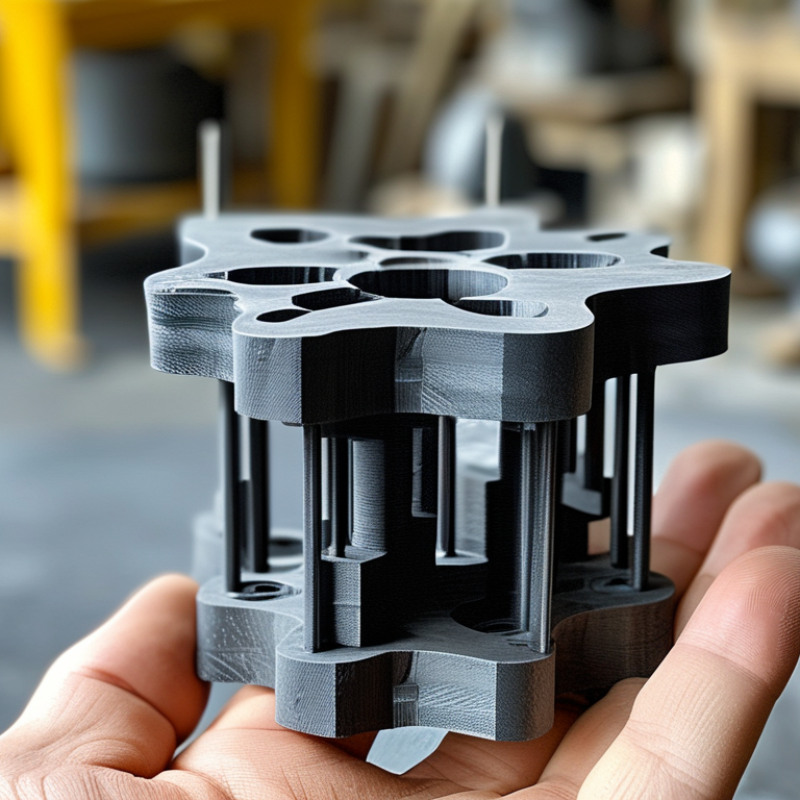
In practical use, manufacturers print brackets, housings, drone components, robotic fixtures, tooling aids, and replacement parts with it. A carbon-filled nylon bracket may feel rigid in the hand, while an ordinary plastic bracket flexes noticeably. The surface can also look matte and finely textured.

But carbon fiber does not make every part stronger in every direction. Printed layers still create weaknesses. The material may become brittle when overloaded, and carbon fibers can wear standard brass nozzles quickly. A hardened-steel nozzle is often safer.

It is easy to oversell this filament. That would be a mistake.

This guide examines what Carbon Filament contains, how it behaves, where it performs well, and when another material may be the wiser choice. Real testing remains essential. A specification sheet cannot fully predict performance in your workshop.
What Is Carbon Filament and What Is It Used For?

Definition and Composition of Carbon Filament

What Is Carbon Filament and What Is It Used For?

Definition and Composition of Carbon Filament

Carbon filament usually means a polymer filament reinforced with carbon fibers. It is not a solid strand of pure carbon. The base material may be a common thermoplastic, while short carbon fibers are mixed through it during production. These fibers can improve stiffness, dimensional stability, and resistance to heat-related movement.

The exact composition varies. Some filaments contain a small percentage of chopped carbon fiber, while others use a higher loading for demanding parts. The polymer still controls many properties, including layer bonding, moisture sensitivity, and impact behavior. Carbon fibers can make a printed component feel rigid, but they may also make it more brittle. The term is not perfectly consistent, so technical data should be checked carefully.

Manufacturers use carbon filament for brackets, fixtures, lightweight housings, and functional prototypes. It can help parts hold their shape under repeated mechanical loads. However, it is not automatically stronger in every direction. A part may perform well along the printed layers and fail across them. Real testing remains important.

Tips: Keep the filament dry before printing. Moisture can create bubbles and weak surfaces. Use a hardened nozzle because carbon fibers are abrasive. Start with conservative print settings, then inspect layer adhesion and warping. I would not trust a carbon-filled part for safety-critical use without controlled testing.

What Is Carbon Filament and What Is It Used For? - Definition and Composition of Carbon Filament

Data Dimension Typical Information Practical Significance
Definition Carbon filament is a continuous, thread-like material made primarily of aligned carbon atoms. In modern engineering, the term commonly refers to a carbon-fiber filament or a bundle of continuous carbon fibers. It provides a lightweight reinforcement material that can be incorporated into composite parts, woven fabrics, tapes, and filament-wound structures.
Primary Element Carbon is the dominant element, typically accounting for more than 90% of the filament mass after carbonization. The exact level depends on the precursor and heat-treatment process. A high carbon content supports high strength, stiffness, chemical resistance, and thermal stability.
Common Precursors The main precursor materials are polyacrylonitrile (PAN), petroleum or coal-tar pitch, and regenerated cellulose such as rayon. The precursor influences the filament’s tensile strength, elastic modulus, electrical properties, cost, and final application.
Manufacturing Stages Production generally includes precursor spinning, stabilization, carbonization, optional graphitization, surface treatment, and sizing application. These stages convert the original polymer or pitch into a strong, oriented carbon structure and improve bonding with matrix materials.
Individual Filament Diameter A typical carbon-fiber filament has a diameter of approximately 5–10 micrometres. The small diameter allows many filaments to share loads efficiently while keeping the overall reinforcement lightweight and flexible.
Filament Bundle Size Commercial bundles, called tows, commonly contain approximately 1,000 to 50,000 or more individual filaments. Tow size affects handling, impregnation speed, surface coverage, production efficiency, and the design of composite reinforcement.
Density Typical density is approximately 1.75–2.20 g/cm³, depending on the precursor and degree of graphitization. The density is substantially lower than many metallic materials, enabling weight reduction in structural components.
Tensile Strength Typical high-performance carbon filaments have tensile strengths of roughly 3–7 GPa, although values vary by grade and processing. High tensile strength makes the filament suitable for carrying loads along its length in reinforced composite structures.
Elastic Modulus The tensile modulus commonly ranges from about 230 to 600 GPa, with higher values associated with highly graphitized grades. A high modulus limits deformation and improves dimensional stability under load.
Electrical Conductivity Carbon filament is electrically conductive, but conductivity varies with fiber structure, heat treatment, and orientation. It can provide electrical grounding, static dissipation, electromagnetic shielding, and resistance-based sensing.
Thermal Behavior Carbon filament tolerates high temperatures in inert or low-oxygen environments, but it can oxidize and lose strength when exposed to air at elevated temperatures. Protective coatings, controlled atmospheres, or suitable matrices may be required for high-temperature applications.
Composite Reinforcement The filament is commonly combined with polymer, ceramic, or metal matrices to form carbon-fiber-reinforced materials. The matrix protects and positions the filaments, while the filaments carry much of the tensile load.
Typical Forms Carbon filament is supplied as continuous tow, yarn, woven fabric, braided reinforcement, unidirectional tape, or filament-wound material. Different forms allow manufacturers to match fiber orientation and material coverage to the load path of a component.
Major Uses Applications include aerospace structures, automotive components, wind-energy blades, sporting equipment, pressure vessels, civil-engineering reinforcement, robotics, and industrial tooling. Its combination of low weight, high strength, stiffness, fatigue resistance, and corrosion resistance supports advanced lightweight designs.
Key Limitations Carbon filament can be relatively expensive, may have limited impact tolerance compared with some metals, and requires careful handling to prevent filament damage and dust generation. Designers must consider impact protection, fiber alignment, matrix compatibility, joining methods, inspection, and end-of-life recycling.

How Carbon Filament Is Manufactured

Carbon filament usually refers to a polymer filament reinforced with short carbon fibers. The fibers improve stiffness, dimensional stability, and heat resistance. It is used for brackets, housings, fixtures, and lightweight engineering prototypes. The result feels firm, but it is not automatically stronger in every direction.

The process begins with carefully dried polymer pellets. Moisture can create bubbles, weak layers, or a rough surface during extrusion. Manufacturers blend the pellets with chopped carbon fibers in controlled proportions. The mixture enters a heated extruder, where a rotating screw melts and distributes the fibers. Temperature control matters. Excessive heat can damage the polymer or shorten the fibers.

The molten material leaves through a small circular die. Cooling fans solidify it while pullers maintain a steady diameter. Sensors check the strand continuously, since slight size changes can affect feeding and printed accuracy. The finished filament is wound onto a spool and sealed with moisture-resistant packaging.

It sounds simple. It is not.

Carbon fibers can increase nozzle wear, so hardened components are often necessary during printing. Fiber alignment may also create stronger properties along one direction than another. This limitation is easy to overlook. In practice, the best results come from testing extrusion settings, layer direction, and part geometry together. Carbon filament is useful, but it should not be treated as a universal replacement for unreinforced plastic.

Key Properties of Carbon Filament

What Is Carbon Filament and What Is It Used For?

Key Properties of Carbon Filament

Carbon filament usually refers to a thermoplastic reinforced with short carbon fibers. The fibers improve stiffness without adding much weight. A printed bracket feels firm, yet remains easier to handle than a metal part. Carbon reinforcement can also reduce shrinkage during cooling, which helps maintain sharper corners and more stable dimensions.

The key property is stiffness, not unlimited strength. Carbon fibers mainly improve performance along the printed layers and extrusion paths. Layer direction still matters. Parts can fail between layers when loaded incorrectly. Carbon filament also offers useful electrical conductivity, thermal resistance, and vibration control, although these properties vary with fiber content and polymer type. It is abrasive, too. A standard brass nozzle may wear quickly. A hardened nozzle is the safer choice.

Market data shows why this material attracts engineering teams. Grand View Research valued the global carbon fiber market at about USD 3.58 billion in 2023. Fortune Business Insights estimated the market at roughly USD 4.05 billion in 2024. These figures differ because research methods and market definitions vary. That difference deserves attention.

Use carbon filament for lightweight fixtures, drone components, robotic tooling, protective housings, and functional prototypes. Dry storage matters. Moisture can create bubbles, rough surfaces, and weaker layers. Printing temperature, cooling, fiber percentage, and build orientation must be tested together. More fiber is not automatically better. Sometimes, a simpler filament produces the more reliable part.

Main Uses of Carbon Filament

Carbon filament usually means a polymer filament reinforced with short carbon fibers. It is not pure carbon wire. The fibers improve stiffness, reduce shrinkage, and sometimes increase heat resistance. According to the MarketsandMarkets Carbon Fiber Market report, the global market may grow from about USD 4.4 billion in 2024 to USD 6.6 billion by 2029. That expansion reflects demand from transportation, aerospace, sporting goods, and additive manufacturing.

Its main use is producing lightweight, rigid parts through material extrusion. Engineers use it for robotic brackets, drone frames, inspection fixtures, protective housings, and low-volume vehicle components. Carbon-filled nylon is useful where impact strength and temperature performance matter. Carbon-filled PLA or PETG is easier to print and suits prototypes, jigs, and visual models. The Wohlers Report 2024 valued the global additive manufacturing industry at approximately USD 20.0 billion in 2023, showing why reinforced filaments attract practical attention.

Still, carbon filament is not automatically stronger in every direction. Printed layers can separate under bending, and the fibers may abrade standard nozzles. Part orientation, moisture control, nozzle design, and infill settings strongly affect results. ISO/ASTM 52900 terminology helps classify additive manufacturing processes, but it cannot guarantee a finished part’s performance. This matters. A stiff bracket may fail suddenly if its layer bonding is poor. In my experience, designers often trust the material label too much and test too little. Carbon reinforcement helps, but it does not replace validation.

Benefits and Limitations of Carbon Filament

Carbon Filament: Benefits and Limitations

Carbon filament usually means thermoplastic filament reinforced with short carbon fibers. Common bases include nylon, PETG, and PLA. The fibers increase stiffness and improve dimensional stability during printing. This helps create lightweight brackets, jigs, housings, and functional prototypes. According to the Wohlers Report 2024, the global additive manufacturing industry reached about US$20.0 billion in 2023. That growth reflects wider use of engineering-grade materials, including fiber-reinforced filaments.

The benefits are practical. Carbon-filled parts can feel rigid and resist bending under moderate loads. They may also show less warping than unfilled nylon. However, carbon filament is not automatically stronger in every direction. Layer bonding remains a weakness. Fiber alignment can create anisotropic parts, especially in vertical sections.

The material can also abrade standard brass nozzles quickly. A hardened nozzle is usually more suitable. Carbon fibers may reduce flexibility and make parts brittle during impact. These limitations matter more than impressive tensile-strength figures. ASTM and ISO additive-manufacturing standards also emphasize testing the final process, not only the raw material.

Tips: Dry moisture-sensitive filament before printing. Use a hardened nozzle and check its diameter regularly. Print several small test coupons first. Measure stiffness, layer adhesion, and impact behavior. Do not trust one supplier’s datasheet blindly. My own practical view is cautious: carbon filament is excellent for rigid tooling, but it can disappoint when toughness or repeated flexing matters.

We will help turn your vision into reality

Contact Us