2026 Best Plastic Wheels for Industrial Buyers?
Choosing the best Plastic Wheel in 2026 is less about picking the hardest polymer and more about matching the wheel to its working conditions. A quiet warehouse cart and a hot, oil-stained production floor need different solutions. Load capacity, floor type, temperature, chemicals, rolling resistance, and noise all matter. So does the hub: a wheel can look robust yet fail early if its bearing or mounting does not suit the equipment.
Materials scientist Michael F. Ashby’s materials-selection framework offers a useful lens. A concise paraphrase for industrial buyers is: “Match the material to the service conditions, not the sales claim.” That is a practical starting point, not a substitute for checking specifications or testing a wheel on the actual route. Ask suppliers for load ratings, operating-temperature ranges, and chemical-compatibility data. Then consider the small details: a sharp threshold, a gritty floor joint, or a cart that stays loaded overnight. They can change wear and handling.
This guide compares wheel materials, designs, and buying criteria for common industrial uses. It also looks at maintenance, total cost, and the trade-offs between durability and floor protection. A lower purchase price may seem attractive. It may not stay attractive after repeated replacements. Some choices remain uncertain until they meet real site conditions; that is worth admitting. Buyers should verify manufacturer data and trial shortlisted wheels under representative loads before ordering at scale.
What Plastic Wheels Are and How They Work
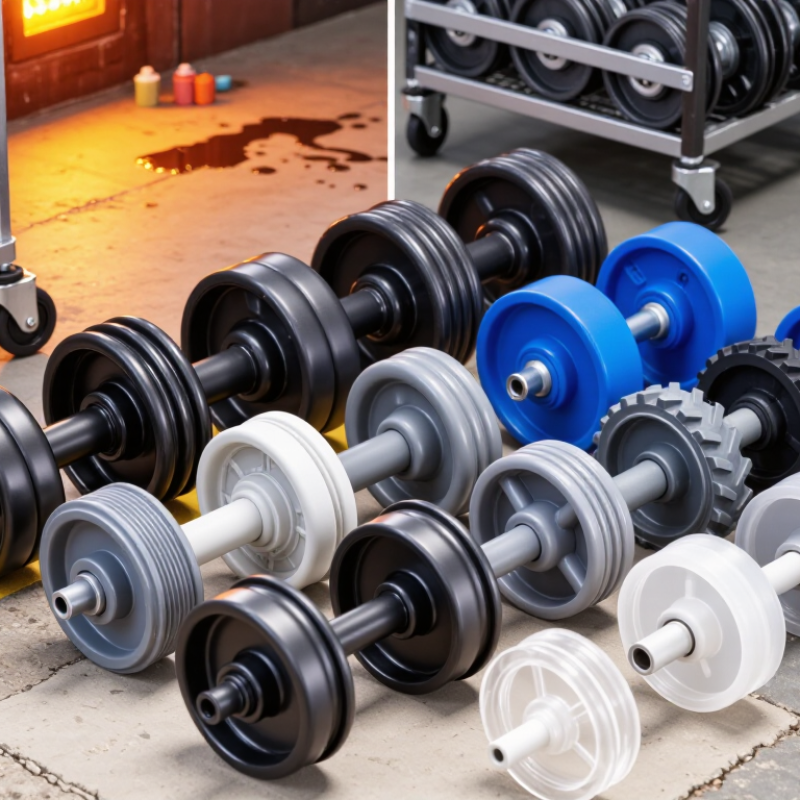
Plastic wheels are wheels made with polymer materials, either as a solid body or as a tread fitted around a hub. Common options include nylon, polypropylene, and polyurethane; each responds differently to load, floor texture, moisture, and temperature. The wheel turns around an axle, usually with a bearing or bushing to reduce friction. As it rolls, its contact patch briefly flattens under weight, then recovers. That small change affects rolling resistance and noise.
Material choice changes how a wheel behaves. A hard nylon wheel may roll efficiently on smooth concrete, but transmit bumps and sound through a cart. A softer tread can absorb vibration and grip better, though it may take more effort to push. Bearings, wheel diameter, and load distribution matter too. A wheel rated for a certain load may perform differently when a cart crosses thresholds repeatedly or remains stationary under weight. Ratings are useful, not magical.
Check the actual floor and operating conditions. A dusty aisle, a damp wash area, and a clean assembly room are not the same test. Look for flat spots, cracks, unusual noise, or rising push effort during routine inspections. Small signs count. Plastic wheels can be durable, but no single material suits every application, and choosing only by price or load rating can miss the real problem.
Common Plastic Wheel Materials and Their Properties
2026 Best Plastic Wheels for Industrial Buyers?
Common Plastic Wheel Materials and Their Properties
Plastic wheels can reduce noise, resist corrosion, and protect floors in industrial settings. The right material depends on load, surface, speed, and exposure to water or chemicals. Nylon is hard and wear-resistant, making it useful for heavy loads on smooth floors. It can be noisy, though, and may absorb moisture, which can affect its dimensions.
Polyurethane offers a quieter, more cushioned ride and good abrasion resistance. It often suits carts moving across concrete or finished floors. Heat limits vary by formulation, so check the supplier’s specifications before use near hot equipment. Polypropylene resists moisture and many chemicals, but it may deform under high loads or temperatures. Acetal has low friction and good dimensional stability. It can cost more. These are trade-offs worth checking against real operating conditions.
Tips: Match the wheel’s rated capacity to the total load, including uneven weight distribution. Check wheel diameter, floor joints, and temperature range. A small trial under actual conditions can reveal problems a catalog misses. It is easy to overlook floor debris.
Key Performance Factors for Industrial Plastic Wheels
Key Performance Factors for Industrial Plastic Wheels
Industrial plastic wheels should be selected by load, floor condition, speed, and operating temperature—not material name alone. ISO 22883:2004 covers castors and wheels used at speeds up to 1.1 m/s, or about 4 km/h. This matters when comparing test results: a wheel rated for slow warehouse travel may not suit faster equipment. Check the maker’s load data under conditions close to your actual use, including whether the load is shared across three or four wheels.
Heat matters. Continuous loads can deform some plastics, while cold environments may make them less impact-resistant. Review temperature limits and test data for compression, wear, and rolling resistance. ASTM D638 provides a method for measuring plastic tensile properties, but tensile strength alone cannot predict wheel life. Ask for application-specific test results, and note the test temperature, load, speed, and floor surface. Small details count: a sharp concrete joint can damage a wheel that performs well on smooth epoxy.
Polyurethane and nylon are common options, but neither is universally better. A harder wheel may roll easily on a smooth floor yet transmit more vibration to the frame and cargo. A softer tread may grip better, but can raise rolling resistance. Check wheel diameter, bearing type, hub fit, and chemical exposure alongside load capacity. One caveat: laboratory figures rarely capture every floor seam or daily impact. Request a trial under real operating conditions when the cost of failure is high.
Industrial Applications and Operating Environments
Industrial applications rarely offer ideal conditions for plastic wheels. A warehouse cart may cross smooth concrete, expansion joints, and scattered grit during one shift. A food-processing area may require frequent washdowns, while a workshop can expose wheels to oil, metal chips, or elevated temperatures. These differences matter. Wheel material, tread shape, and bearing design should match the actual floor and duty cycle, not just the cart’s maximum load.
In practice, buyers should consider load per wheel, travel speed, turning frequency, and how long equipment remains stationary. Hard wheels can roll easily on smooth floors but may create more noise and vibration on uneven surfaces. Softer treads can improve grip and reduce impact, though they may wear faster under heavy loads. Check chemical and temperature compatibility with the supplier’s technical data. A first estimate can still be wrong; trialing a wheel in the real work area often reveals issues that a specification sheet misses.
Tips: Inspect floor joints and debris before choosing. Confirm the load includes the cart and its contents. Test turning and stopping with a representative load. Note wear after regular use, not just on day one. Small differences matter. A wheel that works well on clean concrete may struggle near a loading dock.
How to Select the Best Plastic Wheels for 2026 and Beyond
Choose plastic wheels by duty, not by price or material name alone. Start with the heaviest loaded cart and its floor conditions. Divide total load across wheels, then account for uneven floors, impacts, and turning forces. A wheel that works on smooth concrete may wear quickly on rough joints. Check tread material, wheel diameter, bearing type, temperature range, and exposure to oils or cleaning fluids. Ask for load ratings tested under conditions close to your operation. PlasticsEurope’s Plastics – the Fast Facts 2024 reports 413.8 million tonnes of global plastics production in 2023. That broad figure is not a wheel-performance measure, but it makes recycled content and material traceability worthwhile questions for buyers.
Tips: Measure the narrowest doorway and tightest turning aisle. Record cart load, travel distance, and floor type. Request test data for noise, rolling resistance, and wear. Do not assume a higher load rating guarantees easier pushing.
For 2026 and beyond, compare service life and maintenance alongside purchase cost. Trial candidate wheels on a representative route, including ramps, floor seams, and loaded turns. Track push effort, tread damage, and flat spots over several shifts. A short trial can still mislead; seasonal temperatures and changing loads may reveal weaknesses later. Keep the wheel specification with the cart’s maintenance records.
2026 Best Plastic Wheels for Industrial Buyers: Compare Material Density
Representative density values for common wheel materials. Lower density can reduce wheel weight, but it does not determine load capacity or overall suitability on its own.
Approximate typical values: polypropylene 0.90, nylon (PA6) 1.13, polyurethane elastomer 1.18, phenolic resin 1.35, and acetal (POM) 1.41 g/cm³. Actual density varies by grade, formulation, and reinforcement. Check product specifications and assess load, floor conditions, operating temperature, and chemical exposure before selecting a wheel.